
SSL Secured

All Major Cards Accepted

Apple Pay & Google Pay

2-Day Shipping Available


An age spot is not dark — it is darker than the skin beside it, and that gap is the only reason you can see it. Blanket brighteners lighten both, so the gap survives. Delentigo™ at 4%, its studied concentration, was built to close it instead: in its maker’s eight-week study the pigment reading in treated spots fell 26% while the normally pigmented skin around them moved 16.5%.
60-day refund — opened or not, nothing to send back · Free US shipping · Full INCI published
Start with clean, dry skin.
A few drops, pressed in — before moisturiser.
Sunscreen over it, every morning. Non-negotiable with any pigment work.

Most brighteners act everywhere they’re applied — the spot fades, and your skin tone fades with it. Age spots hold two pigments: melanin, which most actives address, and lipofuscin, the yellow-brown pigment of accumulated cellular wear, which most ignore entirely.
Delentigo™ was built around both, and built to be selective — garden-cress sulforaphane and soy genistein sit in separate vector liposomes, drawn to the elevated oxidative signalling inside the spot rather than acting on every cell they touch.
In an eight-week placebo-controlled study on 12 women aged 40 to 77, applied twice daily to hand age spots — the most UV-damaged, stubborn pigmentation on the body — the pigment reading in treated spots fell 26%, while the normally pigmented skin around them moved 16.5%. The visible contrast between the two closed by roughly half. At four weeks in the same programme, the melanin index of treated spots was down 6.2% against placebo while normally pigmented skin was unchanged.
Here at 4%, the exact concentration those studies used, with MossCellTec™ No. 1 at 2%. Made in Carros, France. Results refer to the appearance of skin.

Most brands run four pigment pathways at a fraction of a percent each. Clarity runs one at the concentration its studies used — and lists everything else in the bottle without pretending it is doing the work.
Every brightener makes the spot lighter. This one closes the gap.
An age spot is not dark — it is darker than the skin beside it, and that gap is the only reason you can see it. Blanket brighteners lighten both, so the gap survives.
Age spots hold two pigments: melanin, which most actives address, and lipofuscin, the yellow-brown pigment of accumulated cellular wear, which most ignore entirely. Delentigo™ was built around both, and built to be selective — garden-cress sulforaphane and soy genistein sit in separate vector liposomes, drawn to the elevated oxidative signalling inside the spot rather than acting on every cell they touch.
In an eight-week placebo-controlled study on 12 women aged 40 to 77, applied twice daily to hand age spots — the most UV-damaged, stubborn pigmentation on the body — the pigment reading in treated spots fell 26%, while the normally pigmented skin around them moved 16.5%. The visible contrast between the two closed by roughly half. At four weeks in the same programme, the melanin index of treated spots was down 6.2% against placebo while normally pigmented skin was unchanged.
It is here at 4%, the exact concentration those studies used, alongside MossCellTec™ No. 1 at 2%. Azeloglicina® sits in the base at 2% — below the level its own studies used, so we make no claim for it. Vitamin C ester, kojic acid and arbutin are base conditioners: named on the label, claimed nowhere.
Why it cannot be dosed any higher. Delentigo™ carries soy isoflavones — the genistein that does part of the work. At 4%, that puts genistein at 0.0056% in the finished serum. The EU cosmetic safety ceiling for isoflavones is 0.007%. We are at eighty per cent of the legal limit, which is the real reason this serum is at 4% and not 6%.
Applied in the morning, under sunscreen. The research is Mibelle Biochemistry's own, into these ingredients rather than into this finished serum.
Contains soy isoflavones. Contains 0.34% alcohol. Patch test 48 hours before first use. Use sunscreen when exposed to sunlight. Results refer to the appearance of skin and vary between individuals.
Ingredient lists use INCI names, which is why a hero active can hide inside words like “isomalt” or “lepidium sativum sprout extract”. So here is the plain version: what we call each active, and how much of it is in the finished serum.
Supplier actives are studied and sold as one complete material, so “4% Delentigo™” means 4% of the material its studies used — and that is the number we hold ourselves to.
| What we call it | How much is in the serum |
|---|---|
| Delentigo™ | 4.000% |
| MossCellTec™ No. 1 | 2.000% |
| Azeloglicina® | 2.000% |
Base conditioners, stabilisers and carriers. Present in the bottle, named here, and claimed nowhere.
Below a concentration of 1%, ingredients may be listed in any order — a standard INCI convention.
aqua (water), glycerin, isomalt, lepidium sativum sprout extract, polysorbate 20, 1,2-hexanediol, hydroxyethylcellulose, propanediol, potassium azeloyl diglycinate, hydroxyacetophenone, polysorbate 80, alcohol, lecithin, sodium ascorbyl phosphate, caprylhydroxamic acid, phenoxyethanol, sodium nitrate, soy isoflavones, disodium phosphate, sodium phosphate, potassium chloride, potassium citrate, kojic acid, arbutin, sodium hyaluronate, polysorbate 60, phytol
Discontinue use and consult a physician if irritation or unexpected reaction occurs. Not recommended for individuals sensitive to any ingredient in this product.
Source: the INCI declaration printed on the carton.
Delentigo™ carries soy isoflavones — the genistein that does part of the work. At 4%, that puts genistein at 0.0056% in the finished serum. The EU cosmetic safety ceiling for isoflavones is 0.007%.
That is the real reason this serum is at 4% and not 6%, and it is also why the soy is on the front of this page instead of buried at the bottom of the ingredient list.
Contains soy isoflavones. Contains 0.34% alcohol, carried in with the active rather than added on its own.
Skin is individual. We print the study’s number and its source — we will not print a date for your face.
Everything on this page can be checked. That's the entire pitch.

If it isn’t for you, tell us and we’ll refund it — opened or not. Keep the bottle; there’s nothing to send back. Sixty days is a refund window, not a results window.
Contains soy. Patch test 48 hours before first use.
60-day refund — opened or not, nothing to send back · Free US shipping · Full INCI published
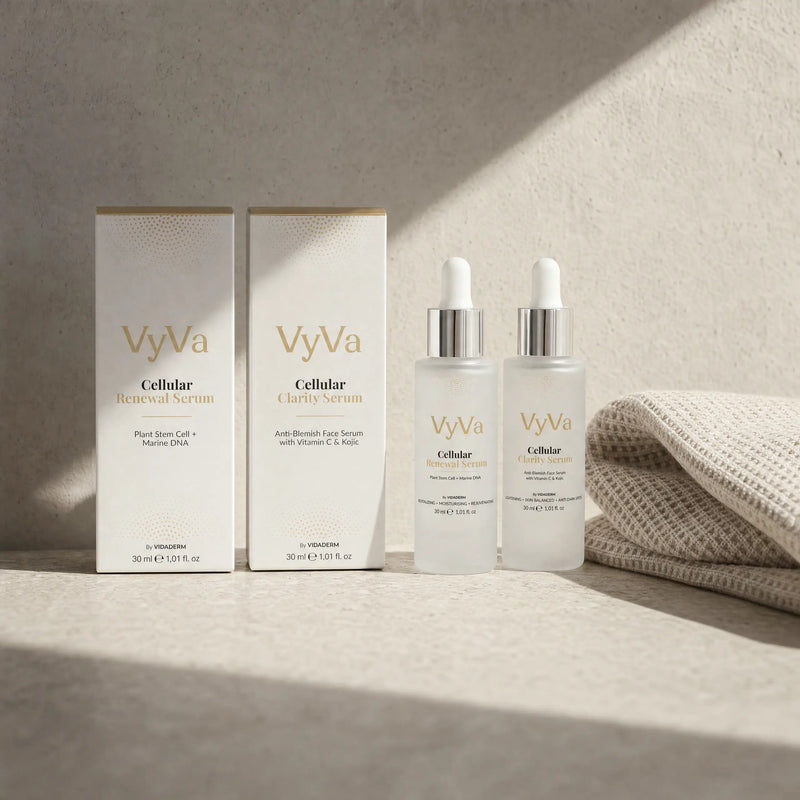 Bare DuoClarity in the morning, Renewal at night — the two-serum routine.One price, from day one until you cancel.$120.95/month subscribed
 The Defence RitualMitoV+ and Cellular Clarity — both before your coffee cools.One price, from day one until you cancel.$92.15/month subscribed
For external use only. Avoid the eye area. Patch test 48 hours before first use. Discontinue use if irritation occurs. Use sunscreen when exposed to sunlight. Keep out of reach of children. Results refer to the appearance of skin. Individual results may vary. Delentigo and MossCellTec are registered trademarks of Mibelle AG.
SSL Secured
All Major Cards Accepted
Apple Pay & Google Pay
2-Day Shipping Available